

When we talk about the quality of online education, much of the conversation centers on the classroom.
Are we teaching the right curriculum? Have we hired excellent faculty? Are our courses well designed? Are students being challenged? Are the assignments and assessments actually measuring whether students are learning?
Those questions matter, and we spend a great deal of time thinking about them.
But there is another part of the student experience that is much easier to overlook when students are learning from their homes, offices, hotel rooms, and wherever else life happens to take them.
Community.
Each semester, we survey our graduating students at the University of Florida College of Journalism and Communications. Our students consistently tell us that they value the education they receive. But when we ask what else they want from their experience, one request repeatedly rises to the top: more opportunities to connect.
They want to meet other students.
They want to interact with faculty outside the boundaries of a class.
They want professional networking.
They want to feel more connected to the college and university they attend.
That presents an interesting challenge for online education.
For years, those of us working in this space have tried different ways to create community digitally. We create discussion spaces. We organize virtual events. We establish social groups. We send messages encouraging students to participate.
Some of those efforts work better than others.
But eventually I started wondering whether we were trying too hard to solve an entirely human need with another piece of technology.
So this year, we tried something different.
We invited our online graduate students to Gainesville.
Taking the online community offline
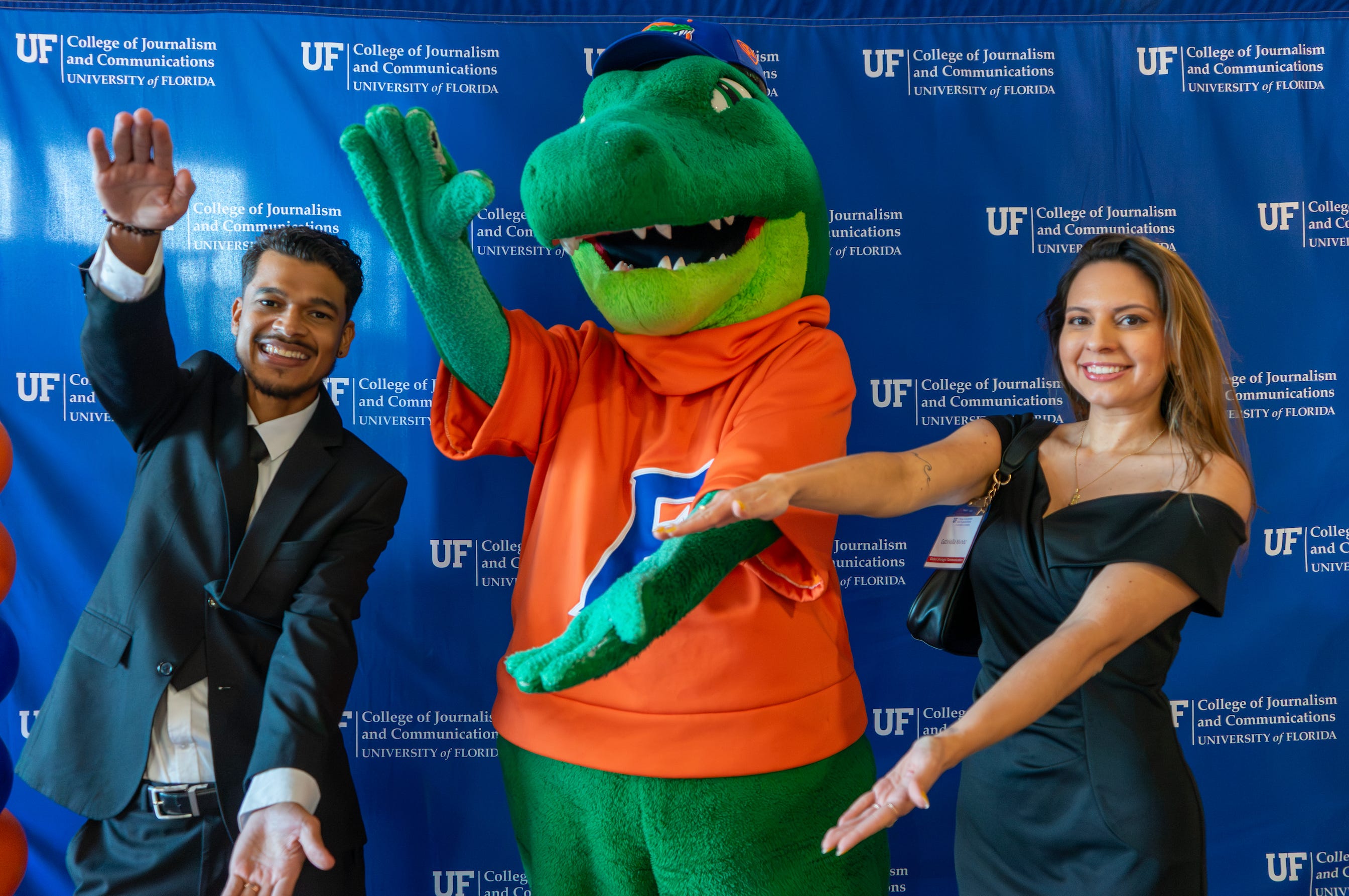
In September, we held our first “Beyond the Screen” gathering for UF CJC Online students.
The premise was simple: Give online students an opportunity to experience the university, meet the people they have previously known primarily through Canvas and Zoom, connect with one another, and spend time together without turning the weekend into another class.
Friday evening began with dinner at Ben Hill Griffin Stadium.
For many students, simply being inside the stadium when it was nearly empty was an experience in itself. We brought in Albert, one of UF’s mascots. We offered professional headshots. Faculty, staff, administrators, and students ate together and talked.
There was programming, but there was also intentionally time to simply meet people.
Saturday became a full day of activities. We had breakfast, a keynote from Dr. Jasmine McNealy on “The Unautomatable Leader,” educational breakout sessions, networking opportunities, lunch, a panel of faculty experts discussing the future of careers in communications, and tours of our college and Weimer Hall.
About 50 students attended.
That number was at the lower end of what we had originally hoped for. But the more I thought about it, the more significant those 50 students became.
These are working professionals. Many have families. They live across the country and, in some cases, much farther away. Coming to Gainesville required airfare or a long drive, a hotel, time away from work, arrangements at home, and an entire weekend.
They did all of that to spend time with a university they normally experience through a computer screen.
That tells us something.
Online does not mean isolated by choice
Students choose online education because they need flexibility.
They may not be able to move to Gainesville. They may not be able to leave work at 2 p.m. to attend a class. They may be balancing careers, children, travel, military responsibilities, or dozens of other commitments.
That does not mean they want to experience their education alone.
We sometimes treat online and in-person education as opposite experiences. I increasingly think that is the wrong way to look at it.
A student can want the flexibility of an online degree and still want to walk across the campus whose name appears on that degree.
They can prefer asynchronous coursework and still want to shake hands with a professor.
They can appreciate Zoom and still want to sit across a table from another student.
They can study hundreds of miles away and still want to feel that they are genuinely part of the institution.
For some students, visiting campus also makes something abstract suddenly tangible.
This is where my professors work.
This is the building I keep hearing about.
These are the people answering my emails.
These are my classmates.
This is my university.
That sense of belonging can be difficult to manufacture through another online platform.
The value has to justify the trip
There was another lesson from our experiment.
If we are going to ask online students to travel, we have to respect what we are asking of them.
An in-person gathering cannot simply recreate things they could have experienced online.
It has to offer value that comes specifically from being together.
Meeting faculty matters.
Professional networking matters.
Being introduced to other students matters.
Walking through the college matters.
Having conversations over dinner that were not scheduled on an agenda matters.
Even taking a professional headshot or getting a picture with the university mascot contributes to an experience that helps students connect their individual online education to a much larger institution and community.
For our students, that community eventually becomes an alumni network as well. The relationships they build during their degree can extend far beyond graduation.
What happens next?
I do not think the lesson from our event is that every online student wants to travel to campus.
They clearly do not.
Nor do I think universities should start requiring online students to participate in physical events. That would undermine much of what makes online education valuable in the first place.
Instead, I think we should expand the way we think about the online student experience.
Excellent online education still begins with excellent teaching, thoughtful course design, meaningful assessment, strong faculty, useful curriculum, and attentive student support.
But education is also relational.
Students learn from one another. Careers grow through relationships. Confidence develops through conversations. A sense of belonging can change how someone sees themselves within an institution and a profession.
Our first event was a test.
About 50 students decided that being there was worth the trip.
They met the people behind their online experience. They met one another. They saw their college. They walked around their university. They learned, networked, talked, laughed, and built relationships.
We still have a lot to learn about how often to offer opportunities like this and what types of experiences students value most.
But I came away from the weekend convinced of one thing.
The convenience that brings students to online education does not diminish their desire for connection.
Sometimes, building a stronger online community may require getting everyone away from their computers.